06. Findings - Game Design Patterns
Findings: On game design patterns
Introduction
In the previous chapter, I outlined the evolution of tool use across the early phases of the project, emphasising emerging tensions in activity. One key outcome of this process was the role of gameplay design patterns (GDPs), which initially emerged through participant suggestions in P1 and were subsequently integrated into a range of scaffolding strategies. These included quick-start activities, instructional tutorials, and code snippet examples, providing graded steps into game making practice.
This chapter shifts focus to the perspectives of participants, using recorded video data and transcript analysis to interpret their varied uses and adaptations of GDPs. In doing so, it addresses RQ2: How can the use of a collection of game design patterns support CGD&P, in particular in relation to abstract and concrete dimensions of existing pedagogies? While software design patterns typically group a description of intended behaviour with a suggested structural solution, often accompanied by worked code examples (see Chapter 2), their educational application remains under-explored. Existing studies have considered game design patterns as tools for co-design (Eriksson et al., 2019) or as scaffolds for simulation-based transfer of conceptual knowledge (Basawapatna, Koh and Repenning, 2010; Repenning et al., 2015). However, little research has examined their potential to support emerging communities of text-based game creators, particularly in overcoming structural and cultural barriers to creative coding. This chapter addresses that gap.
To support the analytical process of this chapter, GDPs are here framed as a form of germ cell, a concept drawn from activity theory to describe a unit of practice that holds the potential for expansive transformation (Blunden, 2014). In this context, GDPs function as small but generative design elements that can be reappropriated, extended, and combined in ways that support both individual learning and wider shifts in community activity. Their varied use by participants, and their role in shaping trajectories of action and interaction, are explored through observational and transcript-based data.
To interrogate the varied use of GDPs, Rogoff’s three planes of analysis (personal, interpersonal, and cultural) are used. This framework informs the structure of this chapter. It begins by examining the role of GDPs in individual appropriation of key game making practices. It then moves to examine their interpersonal use within shared documentation, guided participation, and evolving division of labour. Finally, it considers the cultural dimensions of GDP use, including the propagation of patterns, norming of community practices, and the embedding of cultural repertoires. A discussion section follows, connecting these findings to existing research and conceptual debates.
Recapping the framing of GDPs within activity theory concepts
Activity theory sees the object of activity as a complex construct. In this case, it includes digital, physical, and conceptual elements. It includes the use of software tools to develop code and assets, physical computers for coding, and the varied motivations of participants. The role of game design patterns within the overall activity can be understood as both a design goal to be implemented and a mediational strategy for learning and participation.
In this chapter, as explored in Chapters 3 and 4, I analyse the use of GDPs within both a wider scope of activity systems where participants operate as collective subjects, and at a smaller scope where pairs or individuals are the subjects of activity. However, even within this smaller scope, the object of activity remains complex. To provide additional clarity, the action of implementing a game design pattern is also treated as an important unit of analysis, allowing analysis of GDPs not only as pedagogical scaffolds but also as conceptual anchors for the intervention’s development.
The analysis that follows is organised using Rogoff’s three planes of analysis (Rogoff, 1995) (see Chapter 3.3). This chapter provides evidence and analysis of how GDPs function across these planes, acting as mediational tools that support individual game making ability, shared practice, and broader community development. Specifically, the cultural plane aligns with the community scope of activity depicted in Figure 4.5 in Chapter 4, while the interpersonal and personal planes correspond to smaller scopes which can be interpreted as sub-action within that activity system. Each theme is developed in turn in sections that begin with examples from participant activity, followed by further analysis and discussion.
The role of GDPs in the personal appropriation of concepts and processes
Kafai and Burke’s review (2015) notes the greater number of studies focused on personal dimensions of learning programming and curricular knowledge, and a corresponding deficit regarding social and cultural aspects. Personal appropriation is described in Kafai and Burke’s (2015, p. 4) review of CGD&P as “knowledge appropriation and transformation that is instantiated in the process of making games”. Rogoff’s (Rogoff, 1995) interpretation of personal appropriation is more complex, communicating the bi-directional nature of the process, where individual interpretations of community-gained knowledge are remediated and fed back into the community. The evolving learning design process resulted in activities which align well with the exploration of computational thinking, systems concepts, and other computing concepts and procedures.
Acknowledging the broad coverage of existing research on this aspect of CGD&P, this section is limited in scope and aims to contribute through a narrow focus on code patching and subsequent debugging, and the development of digital literacy skills. I have chosen these areas as they were the subject of numerous observations made in the collected data.
Addressing digital and web literacies first, to integrate new gameplay design patterns or adapt existing ones in their games, participants needed to develop foundational digital skills related to using a desktop personal computer and the use of an internet browser and online tools. The following vignette extract features a mother, Madiha, and daughter, Nasrin (see Vignette V.5 for fuller transcript and analysis).
Madiha has just finished creating a pixel art sprite of an alien, which will comprise a hazard in her game, and comments, “We’re finished. Right what’s next? Now I’m an expert pixel? Now I have to figure out how to get it in there don’t I? Without losing it I’ll be very upset.” Madiha’s emotional investment in her creative work prompts Sonia, a fellow parent, to comment: “Have you saved it?” Unsure of how to transfer the image from the online image editor to the Glitch coding environment, Madiha seeks assistance from her daughter.
Madiha: Nasrin! Nasrin! Nasrin! Do you know how to get it in the game? Nasrin: Oh my god! Madiha: Well. First of all save it to the gallery. How do you save it? Ah there you are. Save it. Is it saved? Right, now export it. Nasrin: Do you even know what export means? Madiha: I know what export means! Nasrin: Ok then, smarty-pants.
Madiha’s implementation of the hazard GDP became a driver for learning wider processes. Here, her investment in the graphical design motivated her persistence to undertake the technical steps and seek support to implement the graphic within her game code. Thus, in this process, the GDP functioned as both a motivational and conceptual tool facilitating the application of technical processes. More broadly, video data showed participants developing fluency in areas such as browser tab use, creating, uploading, and integrating graphical and audio assets, and proficiency in keyboard and mouse use for text manipulation. In line with activity theory, this can be interpreted as the gradual operationalisation of actions that initially required more explicit guidance, as discussed by Leontiev (Leontiev, 2009).
This section now turns to the role of GDPs in relation to the practice of code patching and tactical responses to coding errors. Code patching is a professional technical process used to scaffold the application of new features in computer programming. This patching process became an important technique of the learning design and supporting resources documentation. The following extract from Vignette 1 shows an example of code patching in practice.
Toby finishes playtesting and navigates to the page containing a menu of game design patterns (see Section 5.3.2). He navigates to a code snippet project illustrating a game mechanic of a moving enemy. He takes time to examine the start of the code carefully. Toby then clicks on the tab of his own game code and examines how it is different. He returns to the example code, scrolls down, and examines the code needed to patch into his game, and after hesitation returns to copy the full code needed from the example. He then navigates to the same section of his own code project template, carefully pasting the code into the right area and checking the result, which correctly shows a new enemy moving back and forth horizontally. Toby playtests his game and struggles to get past this new enemy. He tentatively alters parameters of the code and seemingly inadvertently changes the direction of the movement of the hazard to vertical. He laughs and comments to his family: “Mine’s just going up and down! Granny! I’ve got mine to up and down.” Later iterations to his code over the next 30 minutes include changes to allow different moving enemies for each level, and changes to the movement parameters of the enemy in level 2 (see Vignette 1 for more detail).
Toby shows increasing fluidity in the process of navigating between documentation, code, and game preview windows. By way of contrast, his use of supporting documentation to undertake the code patching process is still hesitant and intentional. Debugging is both motivated and facilitated by the participant’s understanding of what the desired GDP should provoke in the target behaviour of the game. Here, the need to get both the starting and ending positions of the movement of the imported enemy provokes several iterations of debugging. Toby’s eventual success in using the code patching and debugging technique was supported by the high level of contextualisation provided by the structuring of the process around GDPs. Although both starting template code and additional snippet-based code were provided, mistakes occurred due to errors in placement and in making additional customisations. More generally, the code patching process often provoked errors within resulting game output in the form of glitches, errors which allow the game to continue to function but which provoke an unintended effect. In my facilitator role, when this happened, I tried to mobilise participants’ existing knowledge of their chosen GDP behaviour compared with the erroneous behaviour of the glitch, sometimes using humour when pointing out the glitch within this process as a strategy to mitigate the potentially frustrating process of debugging.
Turning to a wider analysis of the process of personal appropriation of knowledge within the game making process, I was inspired by the process and rationale of Bevan and Petrich’s (2013; 2015) work, who created a map of learning dimensions to support facilitation of seemingly chaotic tinkering and making processes in museum contexts. During data analysis, the process of attempting a systematic coding scheme resulted in a growing list of curricular, conceptual, and practical constructs. While this list was not used for systematic coding, as explained in Chapter 4, I returned to it in later phases of the design process, when looking to adapt this learning design with a more formal environment in mind. This list formed the basis for a more systematic map of curriculum-oriented concepts that suited exploration within the game making process described in this research. It is included here as Table 6.1.
| Computational Thinking | Coding Concepts | Systems Patterns | Design and Technical Practices |
|---|---|---|---|
| Abstraction | Sequences | Systems Elements | Goal Setting |
| Decomposition | Variables | Systems Dynamics | Being Incremental and Iterative |
| Pattern Recognition | Logic | Reinforcing Feedback Loops | Developing Vocabulary |
| Algorithmic Thinking | Loops | Balancing Feedback Loops | Web Literacy (as a subset of digital literacy) |
| Arrays | Code patching | ||
| Creating Functions | Version Control | ||
| Change Listener | Debugging | ||
| Input Event | Reusing and Remixing |
Table 6.1 - Learning dimensions facilitated by this study’s game making process
The map of learning dimensions in Table 6.1 includes a balance of skills, concrete and more abstract aspects of coding concepts. The creation of these learning dimensions is shared here as a supporting resource aimed at helping future teachers and facilitators locate curricular value within the game making process and to address tensions in the integration of concepts into a complex making process. Such an approach specifically addresses a paradox common in project-based approaches in more formal settings, the tension between an exploratory learning approach and the possibility or need to align with curricular concepts (Hoyles and Noss, 1992). I propose that this tension, named the play paradox by Hoyles and colleagues (1992), can be addressed by employing the learning map as a classroom planning and reflection tool, enabling teachers to identify, retrospectively or prospectively, where curricular concepts are being encountered through learner-led activity, while allowing the leading activity to remain oriented towards participants’ own goals, in this case to add GDPs to the game.
In this informal learning context, the overall motivation of participants was to have fun while making an engaging game together rather than explicitly developing knowledge linked to the computing curriculum, reflected in the overall orientation of this thesis. In this context, the play paradox is less extreme, and my approach to the learning design, facilitation, and the methodology of this study reflects this. However, the learning map demonstrates how similar practices could be adapted for more formal settings, where curricular accountability is more pronounced, without displacing the exploratory character of the activity, a theme taken up in the conclusion.
In summary, this section has provided a selected overview of examples of the personal appropriation of knowledge and processes being driven by the implementation of GDPs. The observations reveal a complex, interdependent relationship between GDP concepts and emergent technical processes. The map of learning dimensions that emerged from inductive and deductive stages of thematic analysis, presented in Table 6.1, contains indications of tensions related to abstract and concrete aspects of knowledge within the implementation of GDPs. These tensions are beyond the remit of this section but are explored in Chapter 7.
GDPs used in the process of guided participation
This section explores how GDPs feature in interpersonal interactions, particularly as tools that support guided participation (see Section 3.3.3) in collaborative tasks. Drawing on video data, I examine how GDPs mediate shared activity, especially in exchanges between children and parents. Three categories are highlighted: the use of the provided GDP menu and documentation, GDPs as tools for project ideation and prioritisation, and their role in shaping the division of labour.
Use of a menu of GDPs to assist project navigation and use of documentation
In this section, I outline findings on the varied use of game design patterns (GDPs) within the game making activity to mediate the process of accessing and using project documentation. Chapter 5 described the introduction of a curated collection (menu) of gameplay design patterns to address the tension between participants’ choice and the need for documentation to support the technical implementation of code structures.
The following extract from Vignette 2 concerns a family that had taken a methodical approach to accessing documentation. In the minutes leading up to the extract, Susanna (parent) was attempting to implement a key and door mechanic in the game. Meanwhile, Tehillah (child), unable to do such coding or debugging, expressed boredom. Susanna(p) 1 had been following the step-by-step written instructions, but when she was unable to progress, she sent Tehillah(c) to get my help. I then worked closely with the parent to identify a syntax problem in the code.
| Dialogue | Activity |
|---|---|
| Susanna(p): Thank you. Did you see Tehillah? Tehillah(c): Did it do it? Susanna: Yes |
Mick (facilitator/researcher) has just ceded computer to Susanna after solving a coding problem. |
| Susanna: I’ll reload it. Here you go | Susanna presses refresh key to reload the game |
| Tehillah: (Laughs) | Tehillah moves laptop to point towards her and takes over using the keyboard |
| Tehillah: (Makes excited cat noise) | Tehillah uses arrow keys to control the game and checks if player progression to level 2 is working. She reaches level 2, where there is no door or key. |
| Tehillah: We need a door in this one. I want to make more levels now. So you can put lots of doors and lots of keys. (in a rhythmic voice) Key Door Key Door Key Door (in a sing song voice) Key Door Level. Key Door Level, Key Door Level |
|
| Susanna moves computer back to take over the keyboard. She changes browser tab and navigates to the code section for level and component design. | |
| Susanna: Well. Where are you going to put your door in level two? Do you want to change the layout at all? |
Susanna gestures to screen |
| Tehillah: What’s door? Susanna: d Tehillah: Ok |
Susanna doesn’t move the laptop but gets closer to take over the keyboard |
| Tehillah: d. Door right there. | Tehillah inserts a “d” in an array high above a platform. |
| Susanna: And where’s the key going? Must be quite hard to get to that door. Key is K |
Table 6.2 - Extract of Vignette 2 showing interpersonal interaction and documentation use.
Vignette 2 takes place after Susanna has been using a tutorial to address the goal of implementing her child’s chosen GDPs. The key and door pattern had been identified in group discussion as one of the harder ones to implement. Susanna is limited in her programming skills but, when possible, avoids seeking facilitator or peer help (see full Vignette 2 in the Appendix). Instead, she independently accesses written step-by-step instructions as a preferred working approach. Susanna leads the process of implementing code changes for patterns chosen by her daughter. The pair use the concept of the key and door pattern to help coordinate their project organisation and access relevant documentation. To prioritise participant engagement in this interaction, the supporting documentation that I had created avoided a principles-first instruction approach (either to the whole group or to individuals). Shorter, just-in-time tutorials were used to maintain engagement, particularly where more extended instruction risked disengagement, especially for children, and in response to barriers associated with literacy (Resnick and Rusk, 2020; Dietz et al., 2021).
This choice over which pattern to implement appears to have a positive impact on affect, both within the data from this vignette and more generally. Tehillah(c)’s choice over which GDPs to tackle has helped create a personal connection to the game. Her positive reaction in the vignette above, including the naming and rhythmical chanting of “key” and “door,” indicates affective engagement closely tied to her interaction with the GDP concept. There is also evidence of affective engagement in Toby’s laughter and calling out to his Granny when getting unexpected results. In the extract from Vignette 1 above, he comments, “Mine’s just going up and down! Granny! I’ve got mine to go up and down.”
I provided participants with a choice of supporting documentation in the form of both step-by-step instructions and code snippets (see Chapter 5). While both forms of documentation follow a structure of close coupling between impact and result, which is core to the use of design patterns in computing education (Gamma et al., 1995), this decision resulted in varied patterns of use. In the Vignette 1 extract above, Toby uses the graphical menu of patterns as a starting point to help him to choose, find, and implement a GDP feature using supporting code snippets directly. In contrast to Vignette 2, he does not access the step-by-step instructions.
While the evidence outlined supports the potential of a menu of GDPs to address the tensions between choice-based approaches and the danger of a lack of relevant scaffolding, there are some important clarifications to make at this point. Firstly, not all participants engaged with the menu. For example, some participants learned to implement GDPs from peers, a process explored in a later section. Additionally, in Vignette 3, we see Ed let his father take the lead in accessing documentation. Secondly, because the GDP menu (and concepts) were introduced by me as a navigational and organisational tool for use by participants, it seems logical that participants should use them for that purpose. The danger here is one of circular reasoning in methodology. Despite these clarifications, the data clearly show the utility of the menu of GDPs to directly help some participants, a clear example of just-in-time documentation supporting participant-led learning and providing a foundational source for the later propagation and evolution of GDP practices by participants.
These observations extend current research in this area in relation to the promising work on computational thinking patterns within the scalable game design (SGD) programme (Repenning et al., 2015). The structure of SGD and supporting resources was oriented around the motivation of transferability of science simulation concepts (in pattern form) to other science disciplines. By way of contrast, in my research the motivation is to align the structure of documentation to the choices of desired game features made by earlier iterations of participants. In this way, project navigation is increased in terms of relatability due to the familiarity participants have with the patterns at play. The use of gameplay design patterns facilitates a tangible coupling between the participant experience of the pattern and the process of implementing it.
GDPs used to scaffold ideation and prioritisation processes
This section outlines how the use of GDP concepts and supporting resources structured around GDPs were used in ideation and project organisation. The impact of the provision of the starter game template and menu of GDPs outlined in Chapter 5 changed the nature of the ideation phase by providing technical scaffolding and a limiting structure to participant design choices.
An exchange from Vignette 3 between participants Ed(c) and Mark(p) shows the use of GDP concepts to help resolve a tension between a more chaotic style of working, jumping from one goal to another, and a parental motivation to prioritise work more systematically. The pair’s initial listing of features is a brainstorming technique using the approximate names of game design patterns (get the person animated, get an enemy in, changing the platforms, make a theme tune). Mark becomes “overwhelmed” with the child’s lack of focus on one pattern: “that’s what I mean, you can’t just skip around like that” (see Vignette 3). This use of GDPs to allow the spatial exploration of design in a visual and intuitive way suits being mapped onto paper or onto graphical software, which allows for similarly rapid prototyping. In a session in Phase 3, Toby uses the code-based tilemap tool to design a maze game instead of a platformer, drawing on existing knowledge of tools and home knowledge of the target game genre to rapidly make revisions without extensive planning (see Vignette 6).
Other pairs take advantage of paper prototyping. For example, Susanna notices her child’s difficulty in using the cursor, delete, and backspace keys to edit a matrix allowing level design. In response, the parent provides a book with grid paper to allow the child to replicate the matrix. The parent is then able to transcribe the design into the code example while engaging the child by checking that she has interpreted the design correctly. Interview data with Mark and Ed (see Vignette 3) uncover complexities in the use of both digital and paper prototyping related to GDPs.
The following exchange (Table 6.3) captures a moment where the GDP concepts are used to structure an ideation exchange, proposing a more radical change to the underlying game genre.
| Dialogue | Activity / Notes / Gestures |
|---|---|
| Dan(p): Have you thought about pushing it a bit further and have a different style of game? Toby(c): What do you mean? |
|
| Dan: Well the previous style of game was a platform game wasn’t it? You went along and there was gravity pushing down. There are other types of games aren’t there? | Dan makes a shape with hands to indicate a platform, then points downwards to indicate gravity pushing on that platform. Mimics a player jumping between platforms. |
| Toby: Pause. I don’t know what to do though. Dan: Well quite, but what other games are there? Toby: I don’t know er. Dan: Well I tell you what… (muffled) Toby: Erm |
Toby navigates to the webpage menu of GDPs. |
| Dan: So. You played them before didn’t you? Toby: What do you mean? Dan: The flying game, that’s a different kind of game. Toby: Oh, like kind of like moving along kind of thing. |
Toby moves hand left to right. |
| Dan: Yeah, and there are games where you are in a world and you have to move around the world like Pac-Man. | Dan points down and moves finger around like an imaginary character moving at right angles. Toby nods. |
| Dan: There are games where things drop down like Tetris. Toby: …game. You could have a game where every 15 seconds, 10 seconds, you could add an enemy to such and such, a random number between such and such. You could block it somewhere. |
Dan makes a shape with hand and moves it up and down. Toby holds up hands to indicate a range of parameters as he says “between such and such.” |
| Dan: So instead of… instead of the world… the world being sideways, we could have the world being looked down on. | Dan re-indicates the change of perspective with hand gestures (see Figure 6.1). |
| Toby: Hmm. How should I do this then? Dan: That’s a good question. Shall we ask Mick to see if that would mess things up or not? |
Table 6.3 - Extract of Vignette 6.
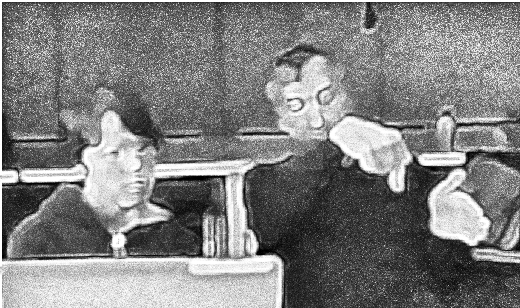
In the vignette extract in Table 6.3, Dan(p) helps Toby(c) via guided facilitation to provoke and shape new design ideas using home-based knowledge of GDP mechanics within this interpersonal plane. Dan draws on game-playing experiences to promote innovation in the design of the existing template: “the previous style of game was a platform (makes shape with hands) game wasn’t it? You went along and there was gravity pushing down. There are other types of games aren’t there?” The pair use their knowledge of gameplay patterns and genre conventions to discuss breaking out of the genre constraints of the starting template. Here they are charting new territory beyond the curated choices of GDPs, and as such we see them developing a new shared vocabulary to express concepts. Both Dan and Toby make extensive use of gestures in their interaction, which reinforces their spoken references to GDP concepts. See Figure 6.1 and Table 6.3 for examples.
Research by Erickson (2000) and Eriksson (2019) (two different researchers) details the use of design patterns, and GDPs in particular, as a lingua franca to facilitate collaboration within design processes. The observations in this section (and the chapter more generally) support and extend existing research on the utility of collective, emergent use of pattern languages as a form of linguistic common ground within communities working on projects. Specifically, data here shows the potential of verbal use of GDPs within ideation, prioritisation, and clarification. Data also indicates that, as well as a verbal lingua franca, GDPs can be a valuable component of gestural interaction and visually oriented prototyping tools, whether digital or paper based.
GDPs aiding the process of division of labour
I now turn to the use of GDPs within division of labour, a process which, as in the previous section, involved their use in an emergent form of communication to construct shared language and understanding (Erickson, 2000). I begin with data in the form of several vignette extracts and additional description in succession before proceeding to commentary and discussion.
Susanna(p) and Tehillah(c)’s working process relied on the parent to do the majority of code implementation on one shared computer. The parent took a lead on many activities but took care that the pair alternated between use of keyboard and mouse. This provided the child with hands-on experience when possible, particularly in level design activities and playtesting (see Vignette 2). In interview data, the parent notes, “I resist the urge to fix things immediately when she (child) struggles.” Another exchange from Vignette 2 is described below.
Tehillah(c) uses the name of a GDP within a request for her parent to take on a specific task within their making process, “Go on then. Key-Door person.” When the parent expresses confusion about what this statement means, Tehillah gestures with her hands to indicate that her mother is the person she is referring to. The child appears to consider the level of complexity needed to add a new pattern into the code to be beyond her ability and thus directly delegates the task to her mother.
At times, Susanna(p) asked Tehillah(c) to seek help from the facilitator. On another occasion, when the child appeared bored of waiting for the parent to solve a code problem, Tehillah(c) approached the facilitator to ask for help on behalf of the adult without prompting. Tehillah also carried out more peripheral activities such as watching older children playtest each other’s games, or observing community activity from under the table.
Toby adopted different working arrangements depending on which family members he attended with. In P1, his mother worried she had abandoned him as she worked on the game code while he concentrated on graphical assets. In P2, Toby created his own game, coding mostly alone but located next to his grandparents, who provided attention and support (see Vignette 1). In P3, he worked in a pair with his father (Dan) in closely guided practice (see Vignette 6 and Table 6.3 above). Toby and Dan’s pair process was more directed and focused than many other participants and included accessing professional documentation and Dan guiding Toby in exploration of computational thinking concepts. For example, Dan takes 20 minutes to lead a detailed exploration of conditional code statements 2. Analysis of the interaction in the session of Vignette 6 shows an emerging pattern.
Dan(p) starts as a facilitator, taking a lead from the direction of the child. As Toby(c) reaches the limits of his ability, Dan begins to be more active by asking leading questions and testing existing knowledge. Finally, in order to complete the programming or research tasks beyond the child’s knowledge, the father is more direct in instruction, directing the research and proposing a coding solution for the game design pattern being worked on.
Madiha’s(p) family, Nasrin(c) and Zidane(c), are all working on separate games on different computers. While Madiha sits next to Zidane, who needs closer support, Nasrin often sits close to her mother but also more closely next to a friend. The following is an extract from Vignette 5.
Madiha(p) calls across the room to draw on Nasrin(c)’s help to correct a design mistake. Nasrin appears reluctant to explain the technical processes she uses to help her mother. Madiha (to Nasrin): “What are you doing? You have to tell me what you are doing so I can do it myself.” Nasrin undertakes a process of using the graphical editing tool. Madiha: “How did you do that so quickly? I’ve got to like, carefully…” As she speaks, Madiha makes hand gestures to show a sense of hesitant keyboard use. In response, Nasrin bounces up in place and smiles broadly.
Madiha(p) and Nasrin(c) at times reverse the parent helping child relationship. On request, Nasrin would, under protest, carry out the required technical elements of GDP implementation on the parent’s game code. However, she would not explain the process of the changes needed, seemingly enjoying the power of knowing something that her mother didn’t. Vignette 5 shows Madiha(p) building an emerging identity as a graphical asset designer. Compared to other coding tasks, this is an area that she wants to build her competency in. Nasrin affects reluctance in her support of her mother, but at other times shows that she enjoys her status as a technical supporter (see reflective commentary in Vignette 5).
In Vignette 3, Mark(p) and Ed(c) break out of a dysfunctional division of labour in the penultimate session of P2. Mark(p) repeatedly steers Ed(c) to pick one GDP to allow them to carefully work through the associated documentation together, a process he later refers to in interview data as plodding (see Vignette 3).
For much of the first part of the session, Mark(p) takes a significant amount of time puzzling over documentation on how to add animation to a character. He reads aloud from documentation: “Mark: In the create function…”. He breaks off to comment on the difficulty involved: “Mark: Quite complicated. But we can do it. But it would mean a lot of mucking around… It’s like a project in itself really.” Ed(c) is left inactive and seemingly to address this tension, the child proposes dividing their labour and working on two separate computers. Ed points to the cupboard in which laptop computers are kept and comments: “Ed(c): Why don’t you go there for a computer and you can do that?” Mark(p): “Why? What? While you’re doing what?” Ed: “Um, making a sound track or something. I could do something like that.” Mark fetches a new computer to continue his focused research but soon joins in Ed’s exploration of sound-making software. They start a process of tinkering and messing about with the capability of music-making tools in a way that spurs creativity.
These examples show the use of GDPs as an organisational strategy, allowing the structuring of work processes in diverse ways. In terms of analysis, in alignment with the framing outlined at the start of this chapter, the conceptualisation of each GDP as an object of an activity system nested within the broader activity of game making allows greater understanding and flexibility regarding the division of labour at play. The decision to work on different GDPs can help participants maintain flow and engagement. In the above example, Ed chooses a different GDP to work on to avoid disengagement. Ed appears to make a tactical decision, allowing the father to specialise in GDPs that involve deciphering technical instructions, whilst he engages with a pattern that involves creating audio and graphical assets in a less technical, more exploratory process. In doing so, Ed(c) breaks out of the more restrictive approach of plodding that Mark(p) advocated for, to engage in experimental, improvised design processes with no clear end goal.
The following examples provide further insight into how GDPs shaped the organisation of work between participants. Some participants took on different roles while working on the same pattern and the same computer. For example, Tehliah(c) designed an enemy, and placed it within level design as her mother coded the pattern. Similarly, some young people and parents began to take on specialist and distributed roles related to a developing identity. This is present in the example of Nasrin(c) and Madiha(p) in Vignette 5 where both are oriented to developing higher quality graphical assets, and Nasrin adopts an additional role as technical support for her mother. Data also demonstrated ways in which the participants divided the process of game making, in a way which revealed traces of home collaboration practices. For example, Toby and Dan’s pair process of accessing professional documentation illustrated an aspect of their family learning culture (see Vignette 6).
The analysis here contributes grounded examples to existing strands of research (see Chapter 2) addressing division of labour within CGD&P and related learning in informal technology settings. Tehillah(c)’s activity away from the screen, such as hiding under the tables and observing others, while non-productive within the scope of technical progress, can be characterised as legitimate peripheral activity, involving observation of community activity (Lave, 1991; Rogoff, 2014). Indeed, the possibility for children to observe and not engage directly in community activities is seen by Rogoff (2003; 2016) as an important characteristic of participation-based models of learning. While the value of this process of messing around is explored in informal learning environments by Ito (2010) and Gee (2004), it is less explored in CGD&P research, especially within this non-formal setting.
Taken together, the observations above provide a case study suitable to inform practitioners looking to benefit from related research on informal emerging roles within joint technology work. The work of Barron et al. (2009) shows parents fulfilling several informal roles, including collaborator, resource provider, learner, non-technical consultant, and emotional support. The work of Roque (2016) provides guidance for helpers in the process, supporting parents to value and feel confident in these roles. Other research shows the potential children have to help parents as technology brokers (Correa et al., 2015). As a relevant contribution, my research shows the potential utility of GDPs to nurture the emergence of organic and flexible divisions of labour and specialist roles.
It follows that the variety of repertoires of helping practice depends in part on the different funds of knowledge that parents and young people have access to. For example, the helping pattern of researching and accessing technical documentation is a key element of Dan and Toby’s working practices (see Vignette 6). This practice is not available to all pairs, due to the level of skill and experience involved. Dan’s experience as a software engineer and volunteer at informal coding clubs is relevant as a fund of knowledge he is able to draw on. The context of the participants as families involved in home education is also relevant. These families are used to learning and working together on projects. They have developed skills and practices which they are able to bring to bear in this activity, but which may not be shared by participants in other contexts.
Use of GDPs in the cultural plane / community level of activity
Continuing the three planes approach to analysis (Rogoff, 1995), this section explores the use of GDPs at the cultural or community plane of activity. Rogoff’s initial discussion of the cultural plane focused on established communities of practice, using the metaphor of apprenticeship to explain how shared norms and practices are taken up by newcomers (1995). Later work with Gutiérrez (2003) moves toward a more dynamic interpretation, placing greater emphasis on cultural activity as contested and emergent. This perspective highlights the role of participants in shaping new repertoires by drawing on knowledge and practices from other communities. Gutiérrez (2008) further extended this view through the concept of third space (see Section 3.2.2), where the repertoires of home and community can mix with those of formal schooling.
While the previous section focused on guided participation and the interpersonal mediation of learning, the emphasis here shifts toward the development of shared repertoires, community norms, and the propagation of practices across the wider learning environment. This section focuses on the cultural plane insofar as it relates to the circulation and repurposing of GDPs within the community, rather than broader questions of identity or long-term transformation. Within this conceptual framing, the following sections explore how GDPs were taken up and repurposed within both existing and emerging repertoires, as part of the cultural activity of the learning community.
The role of GDPs to facilitate learners to design for others
The use of GDPs, particularly during playtesting, can support the process of imagining end-user experiences. This section examines how the concept of, and experience with, implementing GDPs encouraged participants to envision the experience of end users of their games.
In the extract from Vignette 2, Tehillah(c) pursues a quirky design goal during her pair design work, which her parent partner, Susanna, resists. Imagining a shift in perspective to the intended audience at a community level of interaction, the parent draws on the perspective of the imagined player to ensure a sense of challenge in gameplay, a process described in Table 6.4 below.
| Dialogue | Activity |
|---|---|
| Susanna: Are you putting one in your third level as well? | Susanna is referring to inserting new “keys” into the level design, which is possible after implementing the Key and Door pattern in code. |
| Tehillah: Yes and then I’m going to make more levels | Tehillah smiles at Susanna and then looks away for a short while. |
| Tehillah: You do this bit | |
| Tehillah: And then delete those H’s. And in there. | The H’s refer to hazards in the level design matrix. |
| Susanna: No! No! Tehillah: Then, let me do it. |
(Off screen) Tehillah takes over the keyboard. |
| Susanna: It’s no fun having a game with no hazards to avoid. Tehillah: It is for me! |
|
| Tehillah: How do you go that way back? So sorry for deleting… They just… |
Tehillah indicates she wants to delete characters before the cursor. On screen, she deletes all hazards in Level 3 of the game. |
| Back Back Back O O O Back O |
Tehillah laughs. On screen, she adds three coins to Level 3 by inserting “O” characters into the level design matrix. |
| Susanna: Goodness me, what was the point of designing our car with fumes if we’re not going to use it? Tehillah: I don’t know. |
Susanna’s tone indicates frustration. After speaking, Tehillah sighs deeply. |
Table 6.4 - Extract of Vignette 1 concerning designing for others
Susanna(p)’s concern at the child’s deletion of all hazard elements shows an awareness of game balance and the need for a level of challenge from the player’s perspective. “It’s no fun having a game without any hazards to avoid.” However, Tehillah(c) seems determined to remove all hazards. “It is for me!” she replies. She appears aware of the design implications but seems to take pleasure in removing all challenge from the level, as an act of disruptive or subversive play. Tehillah describes her final level, which has only rewards and no hazards, as a “secret, special” experience, indicating that she is playing against the norms of platform game design in a way designed to provoke player surprise.
Some other participants, including Toby and Nasrin, created extremely challenging or even impossible game levels that frustrated other players. However, not all participants were as aware of the experience of gameplay dynamics for others, even when guided by peers during community sessions. Vignette 4 outlines several sequential episodes of participant feedback on the challenge level of Madiha’s game. The discussion of game challenge, particularly comments about the level of difficulty of participant games, was a common interaction during playtesting. The vignette illustrates attempts at norming by other participants in relation to Madiha(p)’s game, to align it more closely with expected standards of platform games. Vignette 4 describes a variety of attempts to influence Madiha to adjust game variables that made controlling her player avatar feel frustrating. The indirect norming behaviours described in Vignette 4 mirror observations seen in the work of Rogoff and colleagues (Rogoff, 2003) on learning in community settings. It appears that norms of gameplay challenge began to emerge through peer interaction, some of which were influenced by participants’ home experiences of game playing.
These examples also serve to highlight two ways in which GDP concepts facilitated the process of designing for others. First, the cultural setting of regular peer playtesting influenced participants’ decisions through shared social feedback. Second, participants were prompted, either directly through advice from partners and peers, or indirectly through observed gameplay feedback, to consider the end-user experience and adapt their GDP implementations accordingly.
These interactions suggest broader implications for how collaborative design and feedback are supported in digital making contexts. This interpretation aligns with research in computer-supported collaborative learning (CSCL), which highlights the motivational and structuring value of public, tangible digital products (Fields, Vasudevan and Kafai, 2015; Xambó et al., 2017). The results here contribute to an area where relatively few studies have explored how CSCL approaches support learning in computer programming (Silva, Mendes and Gomes, 2020). Chapter 2 explored ideas from professional and participatory design traditions, where user experience should inform design practice (Redström, 2006), as well as the challenges of carrying out such an “operationalisation of empathy” (Surma-aho and Hölttä-Otto, 2022, p. 1). From a CHAT perspective, this involves learners shifting perspectives as they engage with different scopes of activity and intention.
The cultural propagation and evolution of GDPs concepts
The implementation of popular or novel GDPs by participant pairs or individuals often spread through peer activity. Participants’ game design choices were influenced by playing the games of others, and at times they would request direct help from peers to implement GDPs they had witnessed in the games of others and within their own games.
In Vignette 1, Toby’s work adding 21 levels to his game is noticed by Bertie, who then asks Toby, “Can you show me how you add more levels onto yours?” The full exchange shows an example of the propagation of GDPs emerging from the process of community playtesting through a direct request. It is also possible that Bertie’s request is prompted by having observed Toby helping Nasrin and Harper with similar tasks. Toby’s emerging role as a specialist that the community can draw on for practical help, and similar examples (see also that of Nasrin in Vignette 5), were welcomed by me as a way to reduce dependence on myself as facilitator, and as an alternative to supporting documentation.
The data shows examples of the organic emergence of novel GDPs and related design concepts beyond those offered in the menu of supporting documentation. Tehillah’s concept of a kind of bonus level that eschews challenge and offers only rewards, explored above, emerged through playful experimentation. While this idea exists in popular games, it was a novel invention for her in context. The concept of a safe zone in the game of Pearl and Clive arrived as a direct result of adding many moving enemies, such that it became essential for players to quickly identify these safe zones where enemies did not reach. Other participants created extremely challenging or impossible game levels that frustrated other players. As with the example of Tehillah above, some participants enacted the game theory concept of defying genre convention during game design (Niknejad et al., 2024). They seemed to take pleasure in ignoring the convention of balance in game dynamics and provoking a sense of surprise or disruption in their audience.
This section follows logically from the previous one in that designing for others and providing more space for social playtesting within the session then leads to the propagation of emerging gameplay patterns. Once concepts like safe zone or bonus level enter the linguistic and coding repertoire of this community of game makers, either from documentation, home gaming knowledge, or genuine innovation, they become available for others to take up and adapt.
The concept of the propagation of project features without any intervention from facilitators is explored in research on informal computing clubs (Maloney et al., 2008; Peppler, Chapman and Kafai, 2009). In interview data, practitioner Matt shared a tension that impacted his practice and led to the decision to orient his club’s activities around guided, focused processes (such as Lego engineering competitions using coding). The contribution here is to propose the use of GDPs, particularly their propagation and incorporation into the developing culture of the creative community, as a structured way to support that process of self-directed participation.
GDPs can facilitate the use of wider interests and funds of knowledge
This section outlines some of the ways GDP concepts are mobilised in the incorporation of participants’ interests from outside the learning space (see Chapter 3.3). In Chapter 5 I outlined the use of the MDA (mechanics, dynamics, and aesthetics) framework to theme the presentation of GDPs. Here, I use the MDA themes to explore grounded examples of how participants drew on home-based interests and knowledge during game making.
Regarding aesthetics, some participants oriented their game making primarily around the aesthetic appeal of their projects. In one example, Madiha(p) identifies herself as an “expert pixel” in the Vignette 4 extract above, emphasising a sense of ownership over the graphical design process. Many examples of session data show an orientation towards graphical design of the visual elements of games as a clear preference for both Madiha and her daughter Nasrin. Supporting interview data confirms that art is a shared interest they pursue in their home activities (see Vignette 4). The process of bringing that creativity into their games made visible their artistic interests within the emerging learning community. In another example, Mark(p) and Ed(c) designed a game around the character of a train driver who needed to collect coal. In interview data, Mark describes the impact of Ed feeling able to bring his interests into the project: “I know just your eyes lit up when you realised you could expand your interests into gaming.” (see Vignette 5) Clive and Pearl, the grandparents of Toby, included a narrative message at the start of their game, surfacing the family’s expertise as beekeepers in a way that sparked interest and conversations with other participants. Families or individuals less engaged with gaming culture often found meaningful entry points through visual or narrative design.
Jumping to game mechanics, Bertie(c) makes comments on Toby(c)’s game, which has a dominant game experience of timed jumping: “It’s like parkour in Minecraft but timed. It’s like playing the game Wipeout. Have you ever played Wipeout?” 3 In this interaction, Bertie draws directly on his familiarity with commercial games to interpret and evaluate the gameplay experience. Mechanics-oriented GDPs provide a clear entry point for participants with strong gameplay literacy, allowing them to articulate design ideas and comparisons without needing to engage first with code-level implementation. In this way, GDPs offer a shared reference point that legitimises gameplay knowledge as a contribution to the design process.
Similarly, Dan(p)’s guidance of Toby(c), explored in Vignette 7, explicitly draws on the child’s home gaming experience to explore an alternative set of game mechanics. Here, GDPs function as a bridge between prior gameplay experience and concrete design decisions, supporting the translation of familiar game behaviours into implementable features such as movement constraints, hazards, or scoring systems. As these features are introduced and tested through shared playtesting, they also become points of reference for discussion and comparison within the group, contributing to emerging norms around what counts as an engaging or fair game challenge. The process of working with game dynamics, including how such features are refined through feedback and comparison with other games, has already been addressed in the previous section.
The purpose of highlighting participant practices through the MDA typology is to suggest that supporting materials can be structured in ways that help participants follow varied entry pathways into game making, aligned with existing home interests and experience. In the same way that the MDA framework can be used by game designers to analyse the component parts of a game, it can also be used pragmatically by learning designers in a CGD&P context to organise collections of GDPs in ways that balance different kinds of engagement, for example visual, narrative, or mechanics-oriented work, within a shared project structure. While the MDA framework itself is not assumed to be ideal or exhaustive for this purpose, offering intuitive organisational structures that allow learners to make meaningful choices about which aspects of a project to engage with has potential value for inclusive pedagogy (Capp, 2017; Sanger, 2020).
While existing work on computational design patterns by Repenning et al. (2015) addresses the motivational value of working with familiar game types and the use of patterns to scaffold programming activity, it is more limited in its treatment of how patterns can be organised to support participant choice in connecting home interests to specific design features. The focus here is therefore not on extending pattern theory itself, but on broadening the scope of how patterns are used within learning design. The following section builds on this by examining how these organisational choices shaped the uptake, circulation, and shared use of GDPs within the learning community.
Discussion
This discussion synthesises the findings of Chapter 6 by focusing on the roles GDPs played as mediational tools across personal, interpersonal, and cultural dimensions of activity. Table 6.5 summarises these roles and provides a reference point for the discussion that follows.
| Category | Use of GDPs | Description |
|---|---|---|
| Personal appropriation | Appropriation of personal knowledge | GDPs supported participants in exploring their own ideas, surfacing computational, design, and systems concepts embedded in games. |
| Fluid design operations | The structure and modularity of GDPs facilitated iterative processes such as rapid prototyping, code patching, and debugging. | |
| Guided participation / interpersonal focus | Framework for supporting resources and navigation | A restricted set of GDPs was used to organise tutorials, documentation, and menus, supporting flexible learner pathways. |
| Scaffolding ideation and prioritisation | GDP concepts were used as shorthand in idea generation, planning, and decision-making during project work. | |
| Supporting division of labour | GDPs acted as a shared language that allowed participants to split tasks, coordinate roles, and build specialisms. | |
| Cultural activity focus | Designing for others | The impact of GDP implementation helped participants imagine and respond to player experiences and feedback. |
| Facilitating the use of home repertoires and interests | GDPs provided a way to incorporate personal, cultural, and home-based practices into game narratives and assets. | |
| Propagation through playtesting | Novel or effective GDP implementations spread between participants through peer interaction. | |
| Components of emerging repertoires in an evolving idioculture | Repeated use and adaptation of GDPs contributed to a shared culture of design practice. |
Table 6.5 - Summary of varied GDP use within the activity of this research
GDPs as mediational responses to a complex object of activity
The synthesis presented in the table above highlights that the object of activity in this study was neither singular nor stable. Rather than working towards a single, clearly bounded goal, participants were oriented simultaneously towards multiple, overlapping aims, including making a playable game, implementing specific gameplay design patterns, supporting or collaborating with others, and exploring personal interests within the project. These orientations shifted within and across sessions, producing a learning environment characterised by ongoing negotiation rather than linear progression. This multiplicity is a structural feature of informal, project-based computer game design and programming (CGD&P), rather than a problem to be resolved.
Within this context of a complex object, GDPs played an important mediational role by enabling the activity to be organised around feature-level goals. By framing aspects of game making as discrete, recognisable patterns, GDPs allowed participants to focus attention on particular elements of a project without requiring agreement on the overall direction or final form of the game. This supported parallel activity, for example where different participants worked on separate gameplay features, visual elements, or mechanics at the same time, while still contributing to a shared project.
The use of GDPs therefore did not reduce the complexity of the object of activity, but made that complexity workable. GDPs functioned as temporary stabilising devices that supported coordination when goals diverged, enabling participants to make progress without resolving all differences in intention or interest. In this sense, GDPs operated as mediational resources that helped sustain participation across varied forms of engagement, rather than as prescriptive steps towards a predefined outcome. While this discussion has focused on GDPs as responses to the complexity of the object of activity, it also points to limitations in how such complexity is typically represented within activity-theoretical models. The following section takes up these representational challenges by considering the extent to which third-generation activity theory is able to account for feature-level mediation and overlapping objects of activity within CGD&P settings.
Representing feature-level mediation and overlapping objects in third-generation activity theory
As outlined in Chapter 5, gameplay design patterns (GDPs) were introduced as design responses to recurring contradictions identified through the design narrative. The focus of the present discussion is not on their emergence, but on how these germ-cell-like units functioned in use as mediational resources within ongoing activity. This shift in analytic emphasis allows attention to move from design rationale to the ways GDPs supported coordination, feature-level work, and participation within a complex and evolving object of activity.
The discussion above highlights a representational challenge when applying third-generation activity theory (3GAT) to informal CGD&P contexts characterised by overlapping and shifting objects of activity. While 3GAT provides a robust framework for examining collective activity systems and their interactions, it tends to foreground relatively stable objects of activity oriented towards shared resolution. In contrast, participants in this study were frequently oriented towards multiple, coexisting aims within a single project, including implementing specific gameplay design patterns, refining particular features, supporting others, and exploring personal interests. These orientations shifted over time and were not always aligned, yet activity continued productively.
Within this context, GDPs mediated activity at a level that sits below the primary object typically represented in 3GAT diagrams. Rather than functioning solely as tools directed towards a single, unified object, GDPs supported work on discrete gameplay features that could be pursued independently, temporarily, or in parallel. This enabled participants to contribute meaningfully to the activity without requiring agreement on the overall direction or final form of the game. Such feature-level mediation is difficult to render within conventional 3GAT representations, which tend to privilege coherence and resolution at the level of the collective object.
Importantly, the way GDPs condensed recurring design problems and possible solutions into compact, recognisable forms positions them as analytically germ-cell-like within this activity system. In this study, GDPs functioned as small-scale, generative units that made a complex and shifting object of activity workable by foregrounding essential relations between design intent, implementation, and gameplay experience. In this sense, GDPs are treated here not merely as scaffolds or instructional aids, but as germ-cell units through which activity could be coordinated at a feature level.
At the same time, there are limits to how far this complexity can be represented by successively elaborating activity-theoretical diagrams or extending existing models. As Engeström and Sannino (2021) note when discussing the challenges of representing fourth-generation activity theory, you cannot just keep “adding triangles”. While this comment is particularly true of transformations and the movement of repertoires between activity systems, analysis of these processes is deferred to Chapter 7, which examines how such units support expansive movement, agency, and longer-term transformation over time. These developmental dynamics require a different analytic focus to that taken in this chapter.
Rather than proposing an alternative activity-theoretical model at this stage, this discussion uses the observations of this chapter to explore how participants worked fluently across such mediational resources in practice. The following section therefore turns to questions of fluency, examining how GDPs supported flexible movement between design, implementation, and collaboration within the constraints of a complex and evolving object of activity.
Developing flexible fluency
Developing the theme of the complexity of the object of activity, this section draws together the discussion of flexible fluency as it emerged across the game making programme, positioning these findings in relation to existing constructionist and CGD&P research. Rather than revisiting the range of motivations for engaging in CGD&P explored in Chapter 2, the focus here is on how fluency was enacted in practice, and how this fluency was supported through the mediational use of gameplay design patterns (GDPs). Returning to my own findings, a recurring concern shaping the learning design was to support participants to remain engaged with game making by enabling movement between different forms of activity, including coding, asset creation, testing, and collaboration. This chapter has identified multiple manifestations of such fluency in the ways participants worked with GDPs. Younger participants in particular demonstrated impressively fluid practice, with rapid shifts between code editing, game testing, authoring assets in online tools, and migrating files, often while talking with peers. Following CHAT, this can be understood as a shift in which previously effortful actions increasingly operated at a more fluent, operational level (Leontiev, 2009).
For many participants, this fluency incorporated improvisational characteristics. Clive(p) quickly added a player health boost after a level, following feedback during playtesting. Tehillah’s bonus level idea appeared to emerge spontaneously (Vignette 2). Pairs often adopted a similar spirit of improvisation. For example, when Dan(p) suggests, “Use paper to design?” (Vignette 6), Toby responds, “I’m just going with it.” In exploring sound-making software (Vignette 3), Ed and Mark engage in tinkering and experimentation, which spurred creativity. Their joint improvisation led to the production of two different soundtracks and a proposal to use different soundtracks for different levels.
Although the learning design placed an emphasis on repeated implementation of GDPs, participant practice rarely aligned with linear or stage-based design cycle models commonly advocated in constructionist research (Resnick, 2007; Wi̇Narno et al., 2020; Dam, 2024). Instead, ideation, planning, implementation, and testing were frequently fragmented or occurred in parallel. Video data includes many examples of participants moving rapidly between these activities, often described by Mark as “jumping around.” These findings suggest that, for many participants, fluency was expressed not through adherence to a graceful design spiral, but through responsive, improvised engagement with available resources.
The findings of this chapter indicate a relationship between such fluid and improvisational practices and the supporting resources that enabled choice over learner pathways, specifically which GDPs to implement and in what order. In this sense, GDPs operated as mediational structures that supported flexible movement between different forms of activity, rather than as steps within a prescribed sequence. This extends constructionist accounts of fluency by foregrounding the role of curated mediational resources in sustaining engagement and supporting participation within complex, open-ended design activity.
Most specifically, the diverse mediational and motivational strategies described in this chapter extend existing studies on the use of GDPs within educational contexts for young people. While Chapter 2 discussed work that addressed aspects of GDP use in a game co-design process (Eriksson et al., 2019), that study focused primarily on GDPs as an analytic tool for researchers, functioning as a lingua franca to structure analysis. By contrast, the present study gives sustained attention to participant use of GDPs in practice, including how patterns were selected, adapted, and combined within the developing context of the game making programme. In doing so, it contributes empirical detail to CGD&P research on how flexible fluency can be supported through the organisation and use of design patterns, without assuming linear progression or uniform pathways through learning activity.
Conclusion
To situate the findings of this chapter in relation to existing research, they can be understood in relation to sociocultural and constructionist accounts that attend to learning across personal, interpersonal, and community planes of activity. At the personal plane, this includes work on the mobilisation of home repertoires, interests, and personalised forms of expression in digital making and CGD&P (Esteban-Guitart and Moll, 2014; Kafai and Burke, 2015). At the interpersonal plane, it resonates with research on social making and gaming cultures in informal learning contexts, where participation is sustained through shared practices, dialogue, and collaboration (Itō et al., 2010; Sefton-Green, 2013). At the community plane, the analysis in this chapter begins to touch on the circulation of shared repertoires, norms, and mediational resources within the emerging learning context (Wenger, 1998; Gutiérrez et al., 2019), with more sustained examination of community-level development and transformation taken up in Chapter 7.
The examples presented in Chapter 6 provide insight into how participants’ tacit knowledge of games, and of gameplay design patterns (GDPs) in particular, were brought into the learning community and mobilised across roles such as ideation, peer feedback, and the division of labour (Wenger, 1998). In this sense, GDPs supported not only individual engagement with game making, but also collective coordination within shared activity.
On a theoretical plane, this chapter has outlined the evolving use of GDPs as mediational resources to support coding repertoires that were often shared across participants. CHAT frames such uses of shared resources and concepts, in this case GDPs, as forms of mediation within activity systems. Through their use, GDPs supported the circulation of technical and social game making practices within an emerging community of learners. GDPs served both researchers and participants by providing a common language through which learners could articulate design ideas and researchers could analyse gameplay experience. The observations in this chapter highlight the diversity and flexibility of GDPs as mediational tools. A key contribution of this chapter is therefore to extend existing work by showing how GDPs supported the integration and ongoing development of participants’ home repertoires within digital making. This positions GDPs not only as a conceptual or analytic tool, but as a scaffold for inclusive, interest-driven learning design that enables participants to draw on prior experience while engaging with new technical practices.
This chapter has begun to address Research Question 2, which asked how a collection of gameplay design patterns can support CGD&P, particularly in relation to the abstract and concrete dimensions of existing pedagogies. The analysis has shown how GDPs helped structure learner activity while also enabling flexible, situated adaptation. The interplay between abstract and concrete dimensions, only briefly developed here, is taken up more fully in Chapter 7 in relation to how participants shaped and reframed the object of activity over time. Rather than framing the design space around fixed goals such as computational fluency or flow, this chapter has illustrated how GDPs supported learners in navigating a complex and evolving object of activity shaped by diverse motivations and forms of participation. In the next chapter, these trajectories are examined through the lens of agency, with particular attention to how participants coordinated intentions and roles in shared activity.
Chapter References
Barron, B. et al. (2009) ‘Parents as learning partners in the development of technological fluency’, International Journal of Learning and Media, 1(2), pp. 55–77. Available at: https://doi.org/10.1162/ijlm.2009.0021.
Basawapatna, A.R., Koh, K.H. and Repenning, A. (2010) ‘Using scalable game design to teach computer science from middle school to graduate school’, in Proceedings of the Fifteenth Annual Conference on Innovation and Technology in Computer Science Education (ITiCSE ’10). ACM Press. Available at: https://doi.org/10.1145/1822090.1822154.
Bevan, B. et al. (2015) ‘Learning through STEM-rich tinkering: Findings from a jointly negotiated research project taken up in practice’, Science Education, 99(1), pp. 98–120. Available at: https://doi.org/10.1002/sce.21151.
Blunden, A. (ed.) (2014) Collaborative projects: An interdisciplinary study. Leiden; Boston: Brill (Studies in critical social sciences, volume 66).
Capp, M.J. (2017) ‘The effectiveness of universal design for learning: A meta-analysis of literature between 2013 and 2016’, International Journal of Inclusive Education, 21(8), pp. 791–807. Available at: https://doi.org/10.1080/13603116.2017.1325074.
Correa, T. et al. (2015) ‘Brokering new technologies: The role of children in their parents’ usage of the internet’, New Media & Society, 17(4), pp. 483–500. Available at: https://doi.org/10.1177/1461444813506975.
Dam, R.F. (2024) The 5 stages in the design thinking process, The Interaction Design Foundation. Available at: https://www.interaction-design.org/literature/article/5-stages-in-the-design-thinking-process (Accessed: 17 July 2024).
Dietz, G. et al. (2021) ‘Design guidelines for early childhood computer science education tools’, in C. Meinel and L. Leifer (eds) Design Thinking Research : Interrogating the Doing. Cham: Springer International Publishing (Understanding Innovation), pp. 291–306. Available at: https://doi.org/10.1007/978-3-030-62037-0_13.
Engeström, Y. and Sannino, A. (2021) ‘From mediated actions to heterogenous coalitions: Four generations of activity-theoretical studies of work and learning’, Mind, Culture, and Activity, 28(1), pp. 4–23. Available at: https://doi.org/10.1080/10749039.2020.1806328.
Erickson, T. (2000) ‘Lingua francas for design: Sacred places and pattern languages’, in Proceedings of the 3rd conference on Designing interactive systems: processes, practices, methods, and techniques. New York, NY, USA: Association for Computing Machinery (DIS ’00), pp. 357–368. Available at: https://doi.org/10.1145/347642.347794.
Eriksson, E. et al. (2019) ‘Using gameplay design patterns with children in the redesign of a collaborative co-located game’, in Proceedings of the 18th ACM International Conference on Interaction Design and Children. Boise ID USA: ACM, pp. 15–25. Available at: https://doi.org/10.1145/3311927.3323155.
Esteban-Guitart, M. and Moll, L.C. (2014) ‘Funds of Identity: A new concept based on the Funds of Knowledge approach’, Culture & Psychology, 20(1), pp. 31–48. Available at: https://doi.org/10.1177/1354067X13515934.
Fields, D., Vasudevan, V. and Kafai, Y. (2015) ‘The programmers’ collective: Fostering participatory culture by making music videos in a high school Scratch coding workshop’, Interactive Learning Environments, 23, pp. 1–21. Available at: https://doi.org/10.1080/10494820.2015.1065892.
Gamma, E. et al. (1995) Design patterns: elements of reusable object-oriented software. Addison-Wesley.
Gee, J.P. (2004) Situated language and learning: a critique of traditional schooling. New York: Routledge. Available at: http://public.eblib.com/choice/publicfullrecord.aspx?p=200413 (Accessed: 6 December 2017).
Gutiérrez, K. et al. (2019) ‘Learning as movement in social design-based experiments: Play as a leading activity’, Human Development, 62(1-2), pp. 66–82. Available at: https://doi.org/10.1159/000496239.
Gutiérrez, K.D. (2008) ‘Developing a sociocritical literacy in the third space’, Reading Research Quarterly, 43(2), pp. 148–164. Available at: https://doi.org/https://doi.org/10.1598/RRQ.43.2.3.
Gutiérrez, K.D. and Rogoff, B. (2003) ‘Cultural ways of learning: Individual traits or repertoires of practice’, Educational Researcher, 32(5), pp. 19–25. Available at: https://doi.org/10.3102/0013189X032005019.
Hoyles, C. and Noss, R. (1992) ‘A pedagogy for mathematical microworlds’, Educational Studies in Mathematics, 23(1), pp. 31–57. Available at: https://doi.org/10.1007/BF00302313.
Itō, M. et al. (eds) (2010) Hanging out, messing around, and geeking out: Kids living and learning with new media. Cambridge, Mass.: MIT Press (The John D. and Catherine T. MacArthur Foundation series on digital media and learning).
Kafai, Y. and Burke, Q. (2015) ‘Constructionist gaming: Understanding the benefits of making games for learning’, Educational Psychologist, 50(4), pp. 313–334. Available at: https://doi.org/10.1080/00461520.2015.1124022.
Lave, J. (1991) ‘Situating learning in communities of practice’, Perspectives on socially shared cognition, 2, pp. 63–82.
Leontiev, A.N. (2009) ‘Activity and consciousness’, Revista Dialectus [Preprint], (4). Available at: https://doi.org/10.30611/2014n4id5173.
Maloney, J. et al. (2008) ‘Programming by choice: Urban youth learning programming with Scratch’, in Proceedings of the 39th ACM Technical Symposium on Computer Science Education, pp. 367–371. Available at: https://doi.org/10.1145/1352135.1352260.
Niknejad, S. et al. (2024) ‘Level up or game over: Exploring how dark patterns shape mobile games’, in Proceedings of the International Conference on Mobile and Ubiquitous Multimedia. New York, NY, USA: Association for Computing Machinery (MUM ’24), pp. 148–156. Available at: https://doi.org/10.1145/3701571.3701604.
Peppler, K.A., Chapman, R.N. and Kafai, Y.B. (2009) The computer clubhouse: Constructionism and creativity in youth communities. 50045th edition. New York: Teachers College Press.
Petrich, M., Wilkinson, K. and Bevan, B. (2013) ‘It looks like fun, but are they learning?’, in Design, Make, Play. New York: Routledge, p. 21.
Redström, J. (2006) ‘Towards user design? On the shift from object to user as the subject of design’, Design Studies, 27(2), pp. 123–139. Available at: https://doi.org/10.1016/j.destud.2005.06.001.
Repenning, A. et al. (2015) ‘Scalable game design: A strategy to bring systemic computer science education to schools through game design and simulation creation’, Trans. Comput. Educ., 15(2), pp. 11:1–11:31. Available at: https://doi.org/10.1145/2700517.
Resnick, M. (2007) ‘All I really need to know (about creative thinking) I learned (by studying how children learn) in kindergarten’, in Proceedings of the 6th ACM SIGCHI conference on Creativity & cognition. ACM, pp. 1–6. Available at: http://dl.acm.org/citation.cfm?id=1254961 (Accessed: 14 March 2017).
Resnick, M. and Rusk, N. (2020) ‘Coding at a crossroads’, Communications of the ACM, 63(11), pp. 120–127. Available at: https://doi.org/10.1145/3375546.
Rogoff, B. (1995) ‘Observing sociocultural activity on three planes: Participatory appropriation, guided participation, and apprenticeship’, in Sociocultural studies of mind. New York, NY, US: Cambridge University Press (Learning in doing: Social, cognitive, and computational aspects), pp. 139–164.
Rogoff, B. (2003) The cultural nature of human development. Oxford [UK] ;a New York: Oxford University Press.
Rogoff, B. (2014) ‘Learning by observing and pitching in to family and community endeavors: An orientation’, Human Development, 57(2-3), pp. 69–81. Available at: https://doi.org/10.1159/000356757.
Rogoff, B. et al. (2016) ‘The organization of informal learning’, Review of Research in Education, 40(1), pp. 356–401. Available at: https://doi.org/10.3102/0091732X16680994.
Roque, R., Lin, K. and Liuzzi, R. (2016) ‘“I’m Not Just a Mom”: Parents developing multiple roles in creative computing’, in Proceedings of the International Conference of the Learning Sciences. Available at: https://repository.isls.org//handle/1/177 (Accessed: 30 October 2018).
Sanger, C.S. (2020) ‘Inclusive pedagogy and universal design approaches for diverse learning environments’, in C.S. Sanger and N.W. Gleason (eds) Diversity and Inclusion in Global Higher Education. Singapore: Springer Singapore, pp. 31–71. Available at: https://doi.org/10.1007/978-981-15-1628-3_2.
Sefton-Green, J. (2013) Mapping digital makers: A review exploring everyday creativity, learning lives and the digital. Available at: http://www.nominettrust.org.uk/ (Accessed: 18 December 2018).
Silva, L., Mendes, A.J. and Gomes, A. (2020) ‘Computer-supported collaborative learning in programming education: a systematic literature review’, in 2020 IEEE Global Engineering Education Conference (EDUCON), pp. 1086–1095. Available at: https://doi.org/10.1109/EDUCON45650.2020.9125237.
Surma-aho, A. and Hölttä-Otto, K. (2022) ‘Conceptualization and operationalization of empathy in design research’, Design Studies, 78, p. 101075. Available at: https://doi.org/10.1016/j.destud.2021.101075.
Wenger, E. (1998) Communities of practice: Learning, meaning, and identity. Cambridge University Press.
Wi̇Narno, N. et al. (2020) ‘The steps of the engineering design process (EDP) in science education: a systematic literature review’, Journal for the Education of Gifted Young Scientists, 8(4), pp. 1345–1360. Available at: https://doi.org/10.17478/jegys.766201.
Xambó, A. et al. (2017) ‘Experience and ownership with a tangible computational music installation for informal learning’, in Proceedings of the Eleventh International Conference on Tangible, Embedded, and Embodied Interaction. Yokohama, Japan: ACM, pp. 351–360. Available at: https://doi.org/10.1145/3024969.3024988.
-
Where unclear, in this writing, the name of the parent is followed by a (p) and that of the child by a (c). For example, Susanna(p) and Tehillah(c). ↩︎
-
Conditional statements let a program choose what to do depending on a test. An equivalent in everyday logic would be: if it is raining, take an umbrella, otherwise do not. ↩︎
-
Parkour in Minecraft and Wipeout are both game experiences whose main gameplay mechanic is about judging jumps and landing accurately. See the reflective commentary “Peer propagation and community uptake of GDPs” in Vignette 1. ↩︎